back
2025 Media Forum: Analyzing Problems and Identifying Solutions
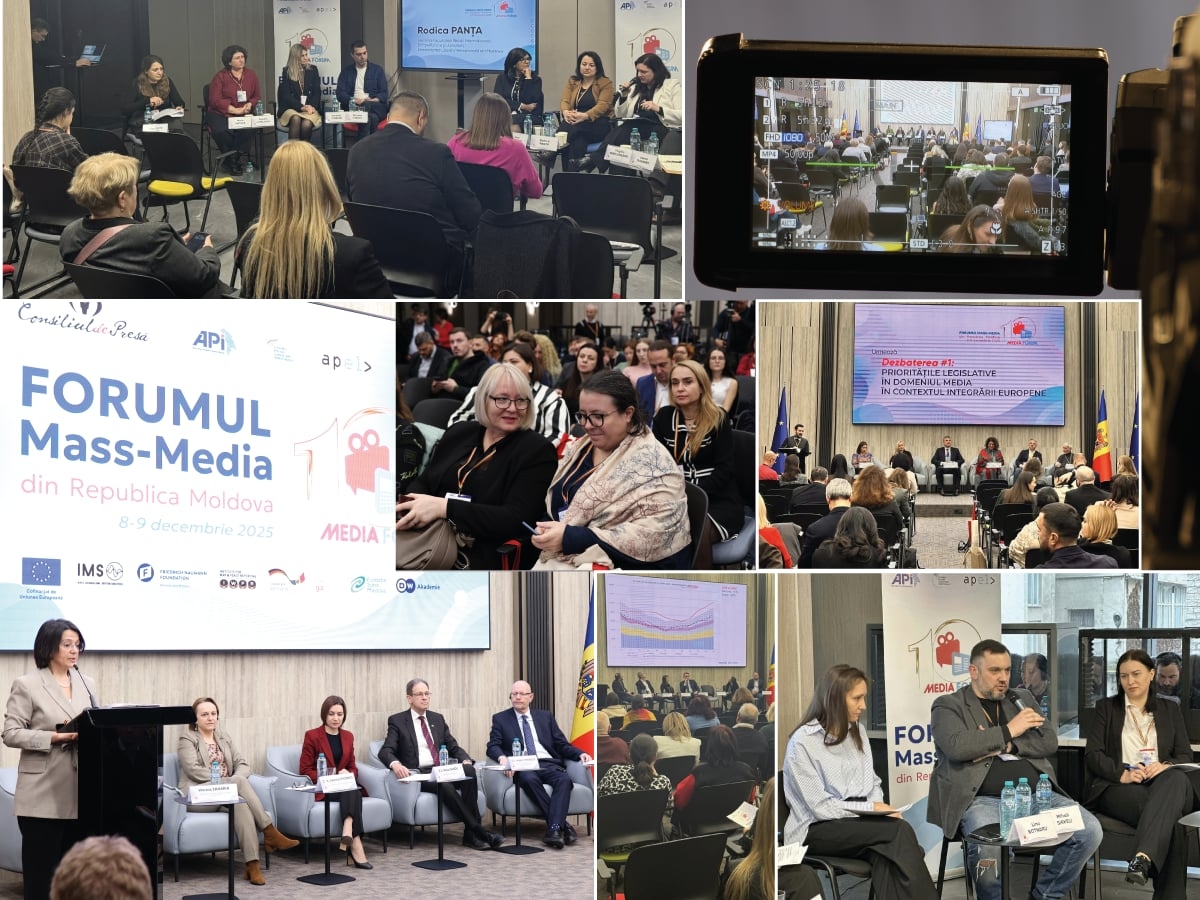
The tenth edition of Moldova Media Forum, the most representative event of the Moldovan journalistic community, took place on December 8 and 9, 2025. More than 230 journalists, editors, media managers, national and international experts, and representatives of authorities and development partners participated in debates about the current state of local media and priorities for the upcoming period. They also took part in professional development workshops and several special events. The Media Forum is convened annually by the Press Council, in partnership with the Association of Independent Press (API), the Independent Journalism Center (IJC), and the Electronic Press Association (APEL).
At the opening of the Forum, Viorica Zaharia, Chair of the Press Council, reviewed developments in the media market over the past year. She emphasized the crucial role of the independent press in exposing fakery in the election campaign, as well as the contribution of investigative reports in revealing networks that seek to destabilize the country. “Over the past year, the independent media has reaffirmed its value and professionalism. I believe that many citizens have been proud of journalists, and that such a press represents them,” V. Zaharia said.
In her welcome message to the Forum participants, Moldovan President Maia Sandu praised the remarkable democratic maturity demonstrated by the journalists. “In the coming years, globally, the battle for democracy will be fought not only at the ballot box or in institutions, but also in the information space. Manipulation, technologies that enable near-perfect falsification, coordinated attacks on public trust, and massively funded propaganda distributed through fake accounts by hostile actors constitute a sophisticated arsenal that generates an extremely volatile information environment. If we do not realize this, prepare ourselves, and join forces, democracy risks being defeated by fakery and manipulation,” M. Sandu said. Messages of support were also addressed by ambassadors from EU member states. “The role of the media in providing accurate and impartial information is indispensable for democratic resilience. Supporting independent media is an investment in democracy. The EU remains steadfast in this commitment,” said Iwona Piorko, the EU's Ambassador to the Republic of Moldova. German Ambassador Hubert Knirsch emphasized that “disinformation is worse than ignorance, and journalists are on the front lines of defense.” Meanwhile, Danish Ambassador Soren Jensen reiterated that “supporting the media is an investment not only in the media sector, but also in Moldova's democratic resilience.”
The first debate of the Forum, “Legislative Priorities in the Media Field in the Context of European Integration” was moderated by Sergiu Niculiță, the program director of TV8. Two groups of speakers attended the debate: journalists and media experts, as well as representatives of public institutions and regulatory authorities. The speakers mentioned that much work remained to align national legislation with European legislation. Liliana Nicolaescu-Onofrei, the Chair of the Parliamentary Committee on Culture, Education, Research, Youth, Sport, and Media, announced that adopting a new media law was a priority. The previous legislature worked on this law, which is to be approved by July 2026. Implementation of current media legislation, legislative priorities, and commitments in the EU accession process was also discussed by Liliana Vițu, Chair of the Audiovisual Council, Cristian Jardan, Minister of Culture, experts Ion Bunduchi (APEL), while Tatiana Puiu (IWPR) and Media Manager Dumitru Țîra (Realitatea) expressed their opinions on this topic.
During the second debate, Julia Haas, an advisor to the OSCE Representative on Freedom of the Media, presented the OSCE's recently developed policy handbook, Safeguarding Media Freedom in the Age of Big Tech Platforms and AI. This was followed by a discussion on the new challenges facing Moldovan journalism. The discussion was moderated by Jan Lublinski, head of department at DW Akademie (Germany). Participants included Marcela Adam, Secretary of the relevant parliamentary committee; Michelle Iliev, State Secretary at the Ministry of Economic Development and Digitalization; Ruslan Mihalevschi, member of the Audiovisual Council; and journalists Cornelia Cozonac (Moldova Center for Investigative Journalism), Anastasia Antoceanu (Agora.md), and Mădălin Necșuțu (TVR Moldova). Several proposals have been made to bolster press freedom in our country. These include implementing the Digital Services Act in 2026, establishing an innovation fund for media outlets, investing in cybersecurity, and imposing stricter regulations on hate speech.
In another debate entitled Election Coverage in the Context of Malicious Foreign Influence, the topic of FIMI (foreign influence and manipulation of information) was discussed in relation to the recent parliamentary elections. Polina Panainte, ADEPT Deputy Director, began by presenting the main conclusions of a report mapping the premises and incentives of FIMI in the electoral context. Subsequently, Ana Revenco, Director of the Center for Strategic Communication and Countering Disinformation; Pavel Postica, Vice President of the Central Election Commission; and Aneta Gonța, Vice Chair of the Audiovisual Council, presented their institutional views on securing the domestic information space. Then, journalists Mariana Rață (TV8), Victor Moșneag (Ziarul de Gardă), and Angela Zaharova (Elita TV, Rezina) discussed the challenges they faced when managing manipulative content during recent election campaigns. “During the parliamentary elections, we were better prepared to combat harmful information influences because we had time to think about what needed to be changed. The changes were painful, as we had to remodel the internal structure of the editorial office. We needed a larger team to increase our online presence, as there was a great deal of manipulation online,” M. Rață said. Victoria Dodon, editor-in-chief of the Mediacritica.md portal, moderated the debate.
Several debates at the Forum addressed issues important to the economic sustainability of media outlets. Representatives of advertising agencies Octavian Hanganu (Media Division), Dorel Samoilă (Publicis Media), and television station representatives Ghenadie Braghiș (PROTV Chișinău), Svetlana Buza (TV8), and Adrian Buraga (Jurnal TV), as well as Alexei Gherțescu, president of the Competition Council, discussed the topic “Advertising Market: Written Rules Versus Unwritten Practices.” A market analysis shows that, although the trend is rapidly shifting toward digital media, where budgets are concentrated on global platforms, television still holds the largest share of advertising. TV stations are facing a shrinking market, unfair competition, and the need to invest in content and reliable audience measurement. Proposed solutions included subsidies to cover audience measurement costs, a revision of advertising legislation, and a redistribution of revenues in favor of private institutions. Stas Popov, the executive director of the Audit Bureau of Circulation and Internet (BATI), moderated the debate.
Why can't we attract enough professionals to newsrooms? Where does the problem lie, in training or the labor market? These questions were discussed at the debate Media Today and Tomorrow: What Professionals We Need, Who Trains Them, and How. The debate included media managers, higher education representatives, and Ministry of Education and Research representatives. Anastasia Nani, the IJC's deputy director, moderated the discussion, which highlighted that the lack of media specialists is mainly due to low salaries, which leads professionals to choose better-paying fields, such as communications or non-governmental organizations (NGOs). Although newsrooms need staff, and there are qualified people on the market, job offers do not match their skills. Universities claim to be adapting to current requirements by offering new courses, collaborating with media outlets, and involving practicing journalists in the training process. The following shared their thoughts on the matter: Adriana Cazacu (Ministry of Education and Research), Laura Tugarev (Department of Journalism and Communication Sciences at Moldova State University), Rodica Panța (Department of International Relations, Political Science, and Journalism at Moldova State University), Virgiliu Mărgineanu (Multimedia Department at the Academy of Music, Theater, and Fine Arts), Maia Metaxa (Moldova School of Journalism), Corneliu Ciobanu (Teleradio-Moldova), Ana Gherciu (Moldova.org) and Renata Lupăcescu (TV Studio L in Căușeni).
The debate, moderated by media researcher Victor Gotișan, discussed international support for ensuring the sustainability of independent media. Representatives of national and local media outlets, Victoria Dumbravă (Agora.md), Mihail Sirkeli (Nokta.md, Comrat); of donors, Lina Botnaru (EU Delegation), Solène Genty (European Endowment for Democracy), Olga Gutuțui (International Media Support), Alexandr Burdian (People in Need), as well as expert Mariia Leonova, a consultant at Jnomics in Ukraine, analyzed the current challenges facing the media sector. The speakers emphasized that, although Moldova's independent press was resilient, it was still fragile. They added that newsrooms further needed internal strategies to cope with economic and political challenges. While support from external donors is essential, it is not a long-term solution. Organizational development, adaptability to new trends, and diversification of revenue sources are essential for newsrooms to survive and develop. At the same time, there is a growing need for stronger cooperation among the media, donors, and experts to create a sustainable ecosystem that could withstand regional and geopolitical challenges.
In addition to the six debates, the Forum hosted three professional development workshops. National and international experts offered practical suggestions based on their experience. Anna Pohrebna, an executive digital producer at Suspilne—Ukraine's national public broadcaster—spoke about effective tools for effectively promoting journalistic products on social media. She discussed the types of content suitable for different social media platforms and explained how to adapt content, text, and images in posts to achieve better audience interaction. In another workshop, Jasper Steinlein, the editorial manager of artificial intelligence at Deutsche Welle (Germany), showed various AI tools that could assist journalists in their daily work. He emphasized the importance of transparent AI tool use and developing clear internal rules in this regard.
At the last workshop, entitled “Online Harassment: How and Where To Complain,” moderated by Alina Radu, editor-in-chief of Ziarul de Gardă, the increasingly pressing issue of insufficient protection for journalists against online attacks and threats was discussed. Participants discussed the implementation of the new amendment to the Code of Contraventions regarding insulting a journalist, as well as provisions in the Criminal Code that obstruct media activity. They also discussed the need for Moldova to adopt measures to protect journalists against abusive lawsuits (SLAPPs). Cristina Durnea, an expert and program manager at the IJC, presented mechanisms for reporting abuse on various platforms. She also made practical recommendations on how to interact with harassers, both physically and online. Viorel Cernăuțeanu, Chief of the General Police Inspectorate, encouraged journalists to file complaints when threatened. Those participating in the discussions included Anton Ialău (Ministry of Culture), Victor Stratu (Ministry of Justice), and journalists Viorica Tătaru (TV8), Veronica Gherbovețchi (Fără Filtre), Liuba Sevciuc (Cu Sens), and Lilia Buracovschi (Realitatea).
A special event at the Forum provided an opportunity to discuss the state of the local press in Moldova, as well as its role in strengthening democracy and combating disinformation. Magdalena Poirier (Head of Culture and Press Section of the German Embassy in Chișinău), Marian Vogel (Regional Director for Eastern Europe and the South Caucasus of the German organization Media in Cooperation and Transition), Cristian Jardan (Minister of Culture), Petru Macovei (Executive Director of API), and Viorica Zaharia (Chair of the Press Council) spoke about trust in local versus national press, separate strategies and programs needed to develop the regional press, and ethical issues, such as excessive use of official press releases and national news stories irrelevant to the region. At the urging of moderator Victoria Dumbravă (Agora.md), journalists and content creators from various regions discussed their experiences and the advantages of participating in the “Beyond Chișinău: Regions in Political Dispute Under the Spotlight.”
The second special event featured a discussion about the future of investigative journalism in the ‘era’ of influencers with Attila Biro, a renowned Romanian investigative journalist and co-founder of the Context.ro portal. He discussed the aspects he considered essential for developing investigative journalism, including information analysis, internal and external collaboration between teams and editorial offices, and adapting to social media algorithms. He also recommended that newsrooms created engaging social media content to direct audiences to journalist sites and be flexible in their approach to artificial intelligence.
The National Award for Ethics and Professional Conduct in Journalism, established by the Press Council, is traditionally presented at the Media Forum. This year, the award went to the journalist Viorica Tătaru. A new edition of the “Black Book of Public Money Waste” was also launched. It features ten well-documented investigations into corruption and the inefficient use of public money. These investigations were carried out by journalists from regional and national newsrooms and focus on issues such as road repairs and construction. Additionally, the winners of the national competition “2025 Investigations of the Year” were awarded.
During the final session of the 2025 Media Forum, participants approved the main text of the Forum Resolution. This document contains findings about the state of the media in the country and requests for the authorities. Until December 16, 2025, journalists and media institutions can submit proposals to supplement the resolution's text. The Forum organizers will then decide whether to include the proposals in the final version of the document.
The Media Forum 2025 was held with the support of the European Union, International Media Support (Denmark), the Friedrich Naumann Foundation for Freedom (Germany), the Institute for War and Peace Reporting, the German Agency for International Cooperation (GIZ), the Soros Foundation Moldova, and DW Akademie (Germany).
